lördag 8 september 2012

Homage to Corsica

This year our family of five went on holiday to Corsica, France. Me and my wife had been there two times already,  before the kids came into the picture. We absolutely loved it and dreamed of returning one day. Little M not being so little anymore (2,5 years), some cheap flight tickets, a few visits to the Gites de France site and the trip was planned.

This year we were a bit too tired for great adventures so apart from doing part of the GR20 the trip mostly consisted of "normal" family vacationing. However, I hope the photos will provide some inspiration, especially for hiking-hungry parents who might be in need of a traditional vacation not too far from the sea, while at the same time being able to do great hikes in stunning scenery. Corsica is just that, "A mountain in the sea" and it's not for nothing that the french call it the "Island of beauty" (Ile de Beauté).


Our view from our first Gite in Pedanu (Pietralba), Les Aiguilles de Popolasca or possibly Les sents D'Asco in the background

We were very happy with our two rented houses. This was the second time we used Gite de France and I'm very pleased with the service we received from the administration and from the house owners. It was swift and friendly. An extra baby bed was arranged in no time.

The first week we did a few small hikes, but with the exception of a trip above Lama it was mostly to visit our favorite bathing spots in central Corsica.


Hiking in the Scala di Santa Regina


"Our own" secret waterfall


Swimming in the Asco

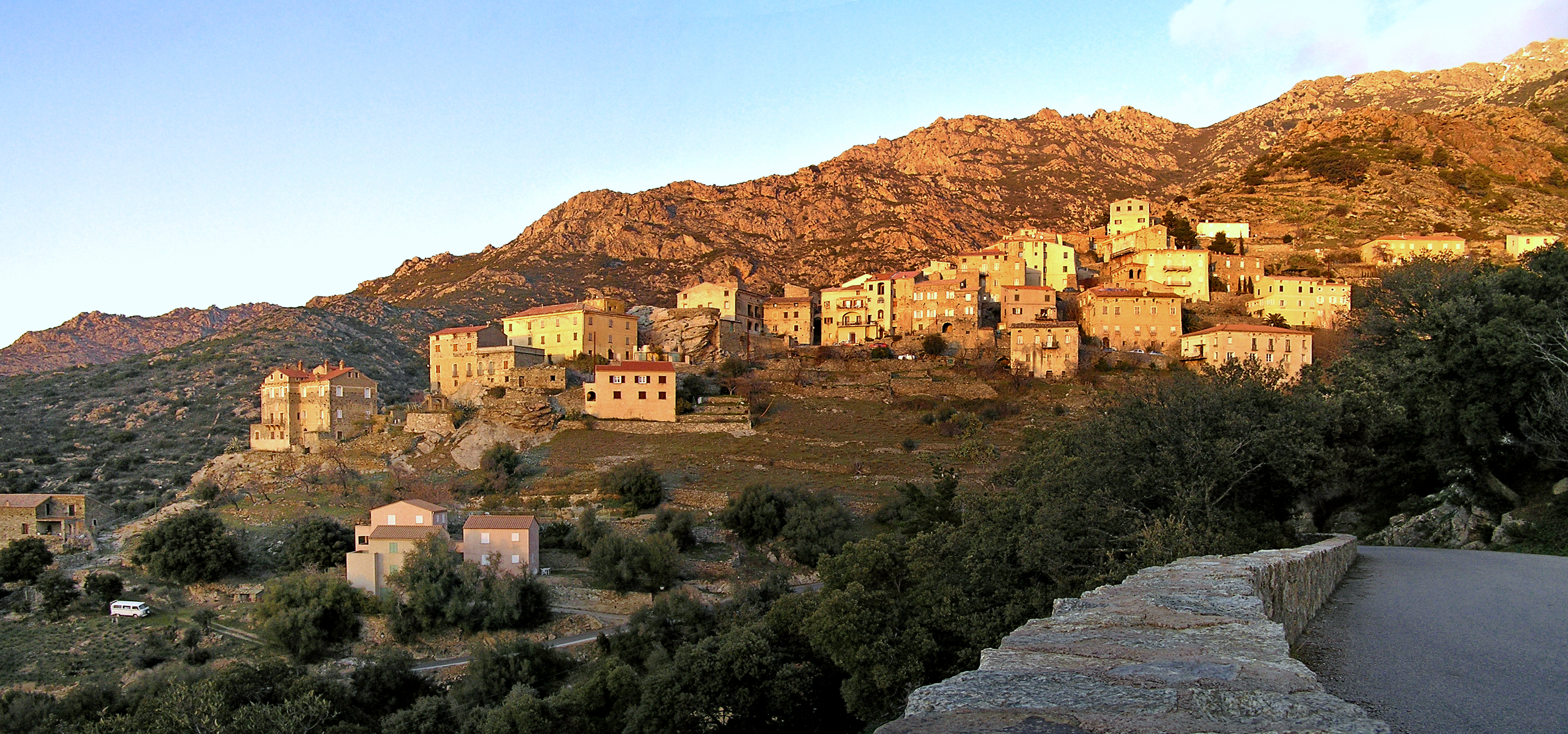
Lama (Picture: Pierre Bona, from wikipedia)

The village of Lama is well worth a visit in itself due to its well preserved typical island architecture, and it is also a good starting place for a hike up the Monte Astu. This is a long hike however and a bit out of range for us. Especially as we like to sleep in the morning. We also had some trouble due to a poisonous plant called the Peucedan. None of us had long trousers (which is recommended) and the blisters you could get from contact with the plant looked quite nasty, so we decided to turn back when we encountered too many of them as we climbed up the mountain.

On the way home from Lama


Hiking late has its advantages - Sunset seen from above Lama

The next week saw us move to the beautiful village of Évisa on 800m of altitude, 24km from Porto. The idea was that the second week would be more hiking oriented. However, as it turned out we ended up spending a lot of time on the coast swimming anyway. The weather was quite hot and the scenery around the Golfe de Porto was absolutely stunning.


Bathing on the beach of Porto

Evisa was a good base for hiking however and we went for short walks in the neighborhood. The free-ranging pigs were always an attraction.

The boy who could talk to pigs

A particularly nice walk on a hot day (almost all days were hot) were the natural pools in the Aïtone forest a few kilometers east of the village on the Chestnut-trail. The huge Laricio pine trees are also particularly impressive here. The Romans used them for building masts for boats.

F exploring the small waterfalls near Évisa

The chestnut trail was especially interesting since it had very nice signs explaining the fascinating story of chestnut cultivation which still is a big affair in Évisa. There is even a good Corsican beer flavored with chestnut, the Pietra.  

Snack break on the chestnut trail


Another nice walk was the Gorges de Spelunca. The best walk and scenically most stunning, is supposed to be a descent from Évisa into the ravine, but to climb up again with the kids did not seem inviting, so we settled for a short walk along the river to the genoese bridge.

How many children can you spot? - Gorges de Spelunca

A nice longer walk a bit south of Évisa is the Lac de Creno. It's a nice little lake not far from the village of Soccia and the walk is easy. Just about perfect as a small challenge for the kids. It takes a bit of time to drive there though. 37km doesn't seem far, but mountain roads take their time. As our landlady pointed out there are 240 turns on the breathtaking 22km road between Évisa and Porto.

Pigs by the Lac de Creno

At the end of our stay it was time for the ultimate adventure: The GR20! A nice little section was chosen: Col de Verghio to Bergeries de Radule. It was an easy walk through the forest leading to an extraordinarily beautifully located shepherds hut.

Going down to the bergerie it was fun to try out an exciting feature on the GR20: The chains!
Negotiating the steep passage near the bergerie


M admiring the scenery around the waterfall from Bergeries de Radule

After arriving it was time for lunch. It was prepared on my gadget of the year: The Caldera Cone. When packing for the trip I thought that the "extremely heavy" (Almost 80g!) caddy for the Cone was very handy since you easily had everything in one neat package. With the exception of one thing: The pot. Something I discovered when it was first deployed to cook some coffee. Necessity is the mother of all invention however and some experimenting revealed that the edge of a large conserve-can could fit (somewhat precariously) in the cone supported by the edge. Coffee could now be brewed and the vacation was saved. For lunch ravioli was prepared directly in the can. It worked OK, but I do not really recommend it since the can had a tendency to fall down in on the burner while stirring. Maybe we will all die of Bisphenol-poisoning too.

Cooking ravioli in the can - works in a pinch

All in all, it was a great vacation. Many gorgeous places still remain to be seen. We will go back again for sure.

Sunset over the Golfe de Porto from the Calanches near Piana

tisdag 28 februari 2012

The unbearable wait for snow and the joy of igloos

Finally we arrived to the snow covered hills of the Orsa Grönklitt ski resort and 70cm of powder snow. Since my Grand Shelters ICEBOX Igloo tool arrived the wait for snow was starting to become unbearable. At last I would be able to test my long awaited new toy. Much time had been spent on studying the instruction manual and watching the included instruction video. Time well spent it would turn out.

The main reason to choose an Igloo as a shelter is not weight savings as I see it. It is the fun and the added comfort you get from a warm shelter. After having built two igloos I can honestly say that I would not yet dare to go out on a trip only equipped with the tool. The construction can certainly fail, and I would not want to be caught without a shelter in a snow storm. The way I envisage using the tool is mostly to provide some fun for the family and also as a base camp for winter hunting trips.

Next time from an igloo base?

First impressions
The Grand Shelters ICEBOX is a really refined product. Every detail seems to be thoroughly thought out and tested in the field. The included instruction manual was very good, but there is a lot to learn and I had to read it a couple of times. The instruction video was also very good.
The tool itself is quite large. Packing it inside a backpack is not a good option. The included pack straps work well though and I could strap the tool to my GG Mariposa without a problem.
The Grand Shelters ICEBOX Igloo tool (Picture linked from http://www.grandshelters.com/)
The first igloo
Almost immediately upon arrival to our rented hut I started to prepare the platform for the first Igloo. My wife had to restrain me from not spending half the night outside in the snow. You should make the pleasure last as they say. I'm not a great fan of snowshoes, but I must say they worked quite well for this job, but I think skis will work well too. This was a quick task done in a few minutes. In field conditions I guess time should be spent to find a good reasonably flat spot as this would probably save a lot of effort.

The ramp and part of the first level
The next day I started the working right after dinner and started work on the first level. I decided to build a two person 8-foot Igloo. The first three blocks are built as ramp with a gradual rise for the next level. As I was doing almost all the work alone the work took time and I only made about a third of the first level that night. Mostly it took a bit of time to get used to the tool and to assemble it correctly the first time. It was amazing to see how well the tool worked with powder snow. The temperature was about -10C and it didn't take many minutes for the blocks to freeze.

The tool with a filled block - Next step is to move the form very carefully to the next position
The next day work went faster and I also decided to skip cross-country skiing altogether that day and spend all my available time on building. Nevertheless it seemed each layer took me around 45 minutes. It takes a lot of extra time to gather the snow yourself. I was quickly getting the hang of it however and the only real trouble I had was when building the blocks on the ramp. The middle ramp block is a bit more tricky.

The difficult nearly horizontal last blocks
On the third day I again skipped skiing. I blamed the onset of a flu, but that was probably just a lame excuse. I was now desperate to get the job done. Up to and including level 5 everything went smoothly, but at level 6 and 7 the blocks start to lean inwards and several blocks broke when I moved the form. It helped to make smaller blocks. At this point things were also getting more complicated since I found it easiest to pack the blocks from inside. This meant I had to shovel snow inside and crawl through the door. This last part would have been a lot easier with two people working. The last blocks where the most challenging and I still haven't figured out how to do these well. Small blocks again seemed to help, but a lot of blocks broke and collapsed. When I started to suspect that a block would break I sometimes took a break for a few minutes to let the block freeze before moving the form. For the last two or three blocks it was not possible to pack from inside, but I had to stand on my snowshoes to pack from the outside.
  
Snowshoes used as steps to reach higher
Finally the Igloo was finished and there was much fun and rejoicing. I was quite amazed that the construction had worked on the first attempt and that the tool makes the Igloo look almost professional. The space inside was really quite large, but a tad too short for a 193cm tall guy like myself. 

A proud builder
Conclusions
The ICEBOX is a fantastic tool, but it takes a bit of practice to master and you need to pay close attention to the instructions. I spent around 5 hours on the first 8-foot igloo and around 4 hours on the second 7-foot solo igloo. Some lessons learned where that good gloves are nice since the snow tends to melt on your hands when you are packing and shoveling. I was quite impressed that my cheap Gore-tex gloves kept my hands dry. My trusty old army leather chopper mitts soaked through. 
Another thing is that a larger snow shovel really helps to speed up the process. Forget the small Snow Claws and even other normal mountain shovels. Bring a big one with lots of capacity. If you are winter camping you are probably using a pulk anyway so the extra weight and bulk is not such a big concern.
As for sleeping in the Igloo, stay tuned, it might even happen this year.

It's all for the kids (big and small)

söndag 18 september 2011

Major highs and minor lows in the Haut-Verdon

This year we spent a large part of the family holiday in southern France. Most of it on the overcrowded riviera, but also a splendid week in the southern alps. The Haut Verdon valley around Colmar to be exact.
This was the first time I spent any longer time in the alps in summertime and I must say the surroundings exceeded my high expectations. Beautiful weather, almost no mosquitoes and excellent paths for family hiking.

Little M on the way to Lac d'Allos
 The day after arriving at our "Gîte" (house or apartment for rent), very conveniently booked on the Gites de France site, we went for a day-trip to the fantastic Lac d'Allos not far from the ski resort Val d'Allos. This is an easy walk with a lot of scenic bang for your efforts. The trail is wide and marmots are commonly seen. 6 year old F and 4 year old S had no problems whatsoever in keeping pace with the adults during the 200 vertical meter ascent. Little M traveled comfortably in the new Toddler Patapum Baby carrier (He had outgrown the baby edition). This baby carrier proved to be a big hit. In my view it is a lot more comfortable than the backpack style baby carriers we've used before. This is probably due to the fact that the child sits so close to your back. A major disadvantage though is that you cannot really put the carrier on yourself alone, but you need someone to help you put the child in it.

To get the most out of our holiday and get inspiration for walks we bought a guide book from Edisud: "Haut-Verdon - Val d'Allos". This book contained a lot of good advice and complemented with a visit to Colmars excellent Tourist Office we had no trouble finding interesting activities.

Sheep grazing on the slopes near Col d'Allos
One of the better walks suggested was to take the car to the Col d'Allos and then walk along the ridge towards La Grande Séolane. The walking was super easy and the views superb all along the way. Cows and sheep grazed on the hillside, the ground was full of flowers, and the marmots greeted us with their alarm chirping. Things couldn't have been much more idyllic (well, perhaps the ski-lift pylons detracted slightly from the beauty.). It was one of the major highs during the trip.

Full speed ahead close to Col d'Allos


Towards the Tete de Vescal - There is something about kids walking with backpacks that makes me profoundly happy 

F with the Val d'Allos in the background

Little M fell asleep in the Patapum near Tete de Vescal
We tried to keep an easy tempo during our holiday so we would only go for more exhaustive walks every other day or so. One of the rest days was spent around the river in the village where we lived. An excellent place to practice river crossings.


S practicing stream crossing in Villars-Colmars
Another day the idea was that we would just do a short walk close to the house up "a small hill". 250m up is no small hill however and what looked like a kilometer from the house was more like a two hour walk. No harm done though, and we were rewarded with magnificent views of the valley. 

View to the north of the Verdon valley from Croix de Puy, Villars-Colmars
The week passed quickly and soon the last day was approaching and with it our greatest planned adventure: The overnight wild-camping hike to Lac d'Allos. We had already hiked up to the lake in the beginning, but it is such a beautiful site that it was worth visiting again. The fact that you are allowed to put up your tent in the Mercantour national park was also a factor.

Gathering all the stuff needed for night in the tent with all three kids took some time. The main problem is bulk, since the kids cannot carry too much in their small backpacks and the one carrying our youngest, little M, aged 1,5 years, cannot carry that much. My main anxiety however focused around if we would be cold in our sleeping bags at 2200m altitude. I got quite mixed answers, but most seemed to think that we would be ok with 10C sleeping bags provided we had good sleeping mats and some extra clothes on. To be on the safe side however I decided to buy a new 0C comfort temperature down sleeping bag for my wife. A cold wife is an unhappy wife and women tend to sleep colder. The price at Decathlon for the S0 Ultralight down bag was very competitive, around 100€, but 1kg for a 0C bag does not really merit the label "Ultralight" in my view.

A Decathlon S0 "Ultralight" 0-degree sleeping bag strapped to the Patapum
A family of 5 also require a bit of space so we had to bring two tents. Cooking gear was skipped however since we could eat dinner at the Lac d'Allos mountain hut. Anyway my Mariposa pack was stuffed like a sausage.

Wild camping with small kids causes bulky loads
Since I knew from the start the kids backpacks were too small I had adjusted the shoulder straps of my homemade silnylon pack to fit S. This allowed for some more space. But unfortunately the fit was not excellent and we had to carry his pack for awhile.
S in front of Lac d'Allos with a modified MYOG 150g silnylon pack

Although modified the bag was too large to fit properly
Having climbed the 200m from the parking the views opened up. Lac d'Allos sits beautifully inside a kettle of mountains. If I remember correctly it was formed by an ancient glacier. The water looks very inviting for a swim, but it is forbidden by park rules. Well, it is probably too cold anyway.

Lac d'Allos with the Towers of Allos in the background

A marmot just a few meters from the trail
View to the west of Lac d'Allos - I probably heard mountain goats battling on this slope
Having arrived at the mountain hut we just had to wait for our pre-booked dinner. The hut proved to be quite well equipped and even had a bar so I could try to relax with the vacations first and only Pastis before supper and enjoy the view. Dinner didn't disappoint either, it proved to be the best dinner we had during our stay. The service was great too. It might not be real wilderness, but the luxurious huts in the alps definitely have their advantages too. I must be careful so I don't get accustomed. Repeat after me: "Freeze-dried food, spiced with mosquitoes devoured in pouring rain IS better than beef casserole washed down with red wine and hot blueberry pie"

The Lac d'Allos mountain hut - a most pleasant establishment
Well fed and happy we sat out to find ourselves a good camping spot for our two tents. My initial plan was to hike one or two kilometers to Plan de Méouille north of the lake, but a nice supper takes it's time so it was already getting dark when we rolled out of the dining room. Luckily there was no shortage of good grassy spots close by with splendid views of the lake as well. I chose a nice clearing somewhat sheltered by big larch trees. My hope was that this would be a warmer spot.

M beams with joy after having "helped" with the tent by removing the front pegs
We split ourselves up between the tents so I would sleep with the older seasoned campers F and S in the Lunar Duo and my wife would sleep with little M in the Cloudburst. "Don't worry", I said, "He will sleep like a log with all the fresh air". In the beginning everything worked according to plan. F and S soon fell asleep after a long and exciting day and M eventually dozed off in his mothers arms.


F and S enjoy the view while winding down before bedtime

SMD Lunar Duo and Tarptent Cloudburst - Having two tents proved to be a great idea
Sleep doesn't come so easily for me in a tent however and after an hour or so I was just starting to fall asleep when M started crying. After a few minutes M was handed to me with the short words: "You take him". The tone hinted that there was no room for arguing. The wild camping was my idea after all. After a few minutes of cradling him in my arms and rocking him gently he fell asleep, but as soon as I tried to put him down on the mattress he started crying again and the delicate procedure of creeping out of the tent, baby in arms, slowly rise up and walk around had to be repeated again. At first there was something very romantic about calming him in the moonlight surrounded by the beautiful landscape, but at 2am after two failed attempts, that feeling faded somewhat. It did not end there either, he would wake up every two hours or so, just when I had found a good position around the annoying rock under my Thermarest. At 6am he was full awake and wanted breakfast. It was starting to remind me of "Strapatz-exercises" in the military, the ones where you could fall asleep while walking. By some miracle however he fell asleep again at 7am and then slept like a proper baby until 9am when we all had to wake up to take down the tents. I've had better camping experiences.

A quite camp in the moonlight
To further enhance the experience it also started to rain during the night. Not that it was a big problem, but it took away the reward of a beautiful morning with a calm breakfast in a stunning environment. Luckily the rest of the family had slept very well in the other tent. No one had been cold. Slowly we gathered all our stuff and set out downhill towards the car one more experience richer. In hindsight I should have trained little M in camping before the trip to make him accustomed to the new surroundings. As I write these lines however, the memories of sleep deprivation have mostly faded away, and despite this minor low, the main recollection remains one of adventure, moonlight over alps and a sense of accomplishment. However, the temptation of good life in the form of hot mountain hut beds, three-course dinners and wine, is luring in the background. After all, there is a time and place for everything.


torsdag 2 juni 2011

A weekend stroll through the local woods

This blog has been a bit quiet lately. Being on parental leave with three small kids tends to take up a bit of time and also a fair amount of energy. Luckily however I managed to squeeze in some time for a weekend walk in the forest close to our summer house north of Stockholm. The plan was to spend two nights outdoors and to have a nice time. There was not really any gear to be tested and quite frankly still my pack ended up a lot heavier than usual due to poor planning. On such a short trip however that didn't really matter.

A female moose near lake Largen spotted from the car on the way out

We started the walk a bit late on friday night since we were delayed by the pleasant company of my parents. So late in fact that when we started to walk through the forest next to the beautiful lake Malmsjön it was already getting dark. Finding a good site for the tent when night is falling is seldom a good idea. Luckily we managed to find an OK spot for our two tents and soon the night was filled with the noise of amateurs in the woods: breaking twigs in the darkness. I also had to use my new lightweight Muela pocket-knife to clear my tent spot from aspen saplings that would otherwise threaten to ruin my sleep. I'm sad to say the knife did not pass the test. When used for serious cutting duty the handle was simply too uncomfortable due to it's rectangular shape. I will switch back to my beloved Opinel. It has a rounded handle and is beautiful in it's simplicity.

A nice roaring campfire

Luckily our chosen campsite was full of dry wood (As is most often the case in the boreal forest) and within minutes we had a nice fire to warm ourselves by. It was quite welcome since the evening was in fact a bit chilly. As always the fire got us in good mood and my hiking buddy Jesper skillfully prepared marshmallows which we washed down with some nice Serbian šlivovic.
A master marshmallow roaster at work
After a large amount of banter it was time to retire to our tents and I found good use for my head-torch.

The Canon S90 working at iso 12800 conveys the darkness. I find the noise adds realism in this case.

I slept reasonably well under my Gatewood Cape. One of the pleasures with sleeping in the woods are all the sounds. This night we were treated with the characteristic cries of a Tawny Owl (Kattuggla, Strix Aluco) just a few meters from our tents.

A bit of condensation on the Gatewood Cape, but nothing too bothersome. I find the Gatewood Cape to be quite ideal for lightweight forest camping.

In the morning we packed up early and left without breakfast in the "Ultralight style" propagated by Mike Clelland!. It was still pretty chilly and we did not feel like lingering around. Jesper even had frost on his tent. It was the first time I tried the postponed UL-breakfast technique and I think it has some merit in cold weather. After an hour or so we had warmed up from the hiking and sitting down was a lot more pleasant.

 Birches in beautiful spring light (not properly conveyed by this photo I'm afraid)

We hiked north along Malmsjön and then turned northwest towards Långsjön by compass bearing. We had no trails to follow on this hike. I just used my Iphone maps and sometimes took compass bearings to keep the course through the forest.

Remnants of a more agricultural age

From Långsjön we just had a few hundred meters to our intended breakfast spot, the lake Mörtsjön in the nature reserve with the same name. Apparently this lake was used by a fly-fishing club. They had installed jetties on several places around the lake. I found that this took away some of the untouched charm from this nice typical forest lake with no road access, but I guess it makes it a very nice place for fly-fishing. There are thousands of lakes like this in Sweden so there is not much harm done.


Preparing hazelnut boosted blueberry soup oatmeal on the Bushbuddy

Jetties or no jetties, the lake was still a nice place for cooking breakfast. I prepared my favourite hiking porridge on the Bushbuddy. I still have some things to learn about this. I managed to severly burn the bottom of the pot. I still haven't managed to properly clean the pot. I must learn to simmer better. Any hints are welcome. I guess one thing I could have done was to put the pot in the pot cozy a bit earlier when the porridge was boiling.

¨
Homemade pot-cozy made by padded aluminium from Bob and Rose doing it's work

The pot cozy really is a nice invention. It saves fuel, time and energy since you don't have to maintain the fire. The extra weight is negligible. In this case we prepared the coffee while the porridge was having a nice time.

Breakfast is finished

After breakfast we walked through the forest roughly following the old boundary between two properties. Somewhere east of Mörtsjön we found what was likely wolf droppings.

Wolf droppings?

This trip took place at the end of April and there was an abundance of spring flowers around. 

Tibast?

Blue anemone and Wood anemone (Blåsippa and Vitsippa)

Vätteros, Lathraea Squamaria. A strange parasitic plant which feeds on it's host.

The sun was shining and we weren't the only ones enjoying it. I nearly stepped on a poisonous black adder in a forest clearing. Lots of dogs have been bitten by these this year. Unless you are allergic their bites are not dangerous, but you should go to the doctor if bitten. From what I've heard you get an an extra tetanus shot.

Black adder

Soon after the snake encounter it was time for lunch. We found a nice place near a hunting tower close to a moss. Out came the frying pan and we had a delicious meal of Nurnberger rostbratwurst and homemade french potato salad (prepared in advance before the trip.). Frying on the Bushbuddy is a bit of a technique as the flames are normally too hot for the pan. You need to hold the pan a bit above the flames and move it around a bit to cover the whole area. When using a normal fire the best thing is to fry over embers, but this doesn't work with the Bushbuddy since the embers are too far away.

Luxury food

After lunch we continued walking. My chosen campsite proved to be quite far away and we noticed that my route was perhaps a bit too long for one day, 20-25km off-trail through forest is quite a distance. The wind was also picking up and it was getting a lot colder. Anyway we plodded along towards the lake Däningen where I had intended to camp. Here we ran into some trouble. The water in the lake really didn't look or smell nice. We had almost run out of water, we were tired and it was almost cold even when we were walking. The lake itself wasn't too interesting either and we didn't really feel like putting up camp there. Maybe I'm starting to become old, anyway we decided to go back home. The last few kilometers to the car we realized just how tired we were. Next time I will research my route better and reduce the distance. Better research as to reliable water sources would also be a good idea.
Even though we aborted the trip a bit early it was great to get out and a great way to switch environment.